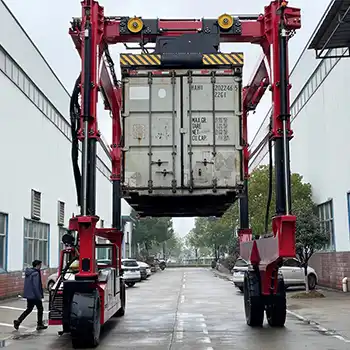
Telescopic Toplift Straddle Carrier for Container Handling
Telescopic toplift straddle carrier system for container yards and warehouses. Efficient container lifting, stacking, transport, and cargo handling.
| Crane Type | Telescopic Toplift Straddle Carrier for Container Handling with Container Spreader |
| Crane Capacity | 30 ton to 80 ton |
| Span Length | Customized |
| Lifting Height | Customized |
| Coverage Area Type | Square / Rectangular, Linear travel / Rotation 360 Degree Steering |
| Application | A telescopic toplift straddle carrier system is used for flexible handling, stacking, and transport of containers (20–40 ft and larger) in ports, yards, warehouses, and logistics hubs, as well as for heavy cargo like steel, precast concrete, and ESS conta |
| Certifications | CE / ISO / SGS / Other third-party inspection |
| Customization | Customized material handling cranes solutions available for indoor, outdoor, hazardous, corrosive, c |
Category: Straddle Carrier
Tags: straddlecrane
Your Trusted Straddle Carrier Crane Manufacturer & Supplier
TELLESCOPIC TOPLIFT STRADDLE CARRIER SYSTEM
Technical & Application-Oriented Buyer Guide
Telescopic toplift straddle carrier system for container yard stacking, inland depot logistics, and warehouse transfer operations. A flexible alternative to reach stackers and RTG cranes for modern container handling systems.
System Overview: Why This Equipment Type Exists
Modern container handling is no longer only about lifting containers from one point to another. In real container yards, inland depots, and warehouse buffer zones, the working conditions change all the time. One day the yard is full, the next day it is half empty. Sometimes the ground is tight, sometimes the stacking height becomes the main issue. So the equipment needs to adjust, not the other way around.
That is where the telescopic toplift straddle carrier system comes in. It is built for situations where fixed infrastructure does not fit well, especially in expanding or mixed-operation logistics sites.
Why Traditional Container Handling Systems Struggle
Traditional container handling systems often struggle when the operation becomes flexible or irregular. In many industrial projects, buyers face the same practical limits again and again.
- RTG cranes depend on fixed rails, which means installation cost and long planning cycles
- Reach stackers can lift containers efficiently, but stacking geometry becomes limited in tight yard layouts
- Terminal tractors handle transport, but still need separate lifting equipment to complete the workflow
In practice, this leads to more machines, more coordination, and more space usage than expected.
Why the Telescopic Toplift Straddle Carrier Was Developed
The telescopic toplift straddle carrier system is developed to reduce this dependency on multiple systems. It brings several functions into one integrated machine, which is especially useful in container-heavy environments where efficiency depends on movement flow, not just lifting capacity.
It combines three core working ideas:
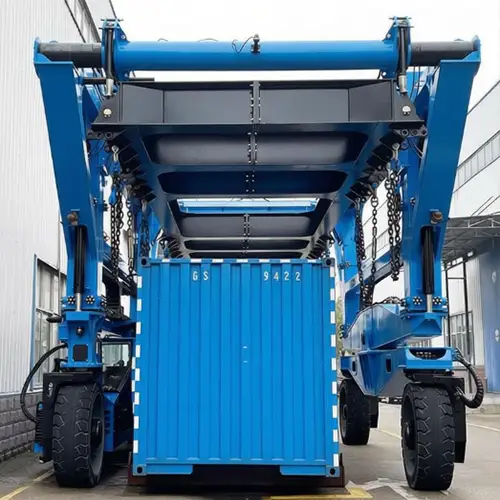
- Mobile straddle frame movement that allows the machine to travel directly over container rows
- Telescopic vertical adjustment to handle different stacking heights and uneven yard conditions
- Standard toplift ISO container handling using corner casting engagement for stable lifting
What the System Achieves in Real Industrial Projects
In real industrial projects, this combination is not about adding complexity. It is more about making container handling less fragmented. One machine handles transport, lifting, and stacking without switching between different equipment types.
- Container pickup and placement in a single workflow
- Adaptable lifting height depending on yard stacking condition
- Stable handling of standard ISO containers (20ft, 40ft, 45ft)
Why Flexibility Matters in Container Yard Operations
So instead of building the operation around fixed cranes or multiple machines, the rubber tyred straddle carrier crane system allows the yard to stay flexible. And in container logistics, flexibility often decides how smoothly the daily operation actually runs.
What Is a Telescopic Toplift Straddle Carrier System?
A telescopic toplift straddle carrier system is a mobile container handling machine used in container yards, inland depots, and logistics terminals. In simple terms, it is a machine that can move freely, lift containers directly, and place them in stacking positions without needing rails or fixed crane structures.
In many industrial projects, this type of equipment is chosen when the yard layout is not fixed or when operations need to stay flexible over time. It runs directly over container rows and works in the same space where containers are stored.
Where This Equipment Is Used
- Used in container yards, inland depots, and warehouse logistics zones
- Operates without rail tracks or fixed crane foundations
- Suitable for flexible and changing yard layouts
Yard Movement and Operation Style
The machine travels over container rows, which is why it is called a straddle-type system. It moves in the same working area where containers are stacked, so there is no need to transfer containers between multiple machines just to complete one cycle.
In real operation, this makes daily handling more direct. You pick, move, and place containers within the same workflow.
- Travels across container rows and stacking lanes
- Works directly inside storage and handling zones
- Reduces unnecessary container transfer steps
Toplift Lifting System (ISO Handling)
For lifting, the system uses a toplift spreader. This is the standard method used in ISO container handling. It connects to the corner castings of the container and holds it securely during lifting and transport.
It is a simple interface, but very practical in daily use. Operators are already familiar with it in most ports and yards.
- Engages ISO container corner castings directly
- Suitable for 20ft, 40ft, and 45ft containers
- Provides stable lifting during movement and stacking
Telescopic Height Adjustment System
The system also includes a telescopic lifting structure. This part allows the lifting height to be adjusted depending on the stacking condition in the yard. In practice, not every yard has perfect or uniform stacking levels, so this adjustment becomes important.
Sometimes containers are stacked two high, sometimes four high. The telescopic function helps the machine adapt without changing equipment.
- Adjustable lifting height for different stacking levels
- Works in uneven or mixed-height container stacks
- Helps in warehouse zones with limited vertical clearance
Core Working Function
At its core, the telescopic toplift straddle carrier system is designed to combine movement, lifting, and stacking in one machine. Nothing complicated in daily use, just a direct workflow.
It works like this in real operation:
Transport + lift + stack containers across flexible yard layouts without fixed rails.
- Transport: moves containers across yard and depot areas
- Lift: picks containers using toplift spreader system
- Stack: places containers at required position and height
In practical container handling projects, this setup reduces the need for multiple machines working in sequence. It keeps the flow inside the yard more continuous, especially in operations where space and time both matter.
Telescopic Lifting System - Height Adaptation Mechanism
A telescopic container handler / adjustable height straddle carrier is designed to solve one key problem in real container yards: different stacking heights in the same working environment.
Instead of relying on separate cranes for different lifting levels, the system integrates vertical adaptability into one machine, making container handling more continuous and less dependent on fixed infrastructure.
How It Works — Container Stacking Telescopic System
The telescopic lifting system allows the lifting frame of the straddle carrier to extend or retract. This vertical adjustment makes it possible to handle containers at different heights and adapt to various yard or warehouse conditions.
In practice, this means one machine can work with stacked containers of different layers without needing separate cranes.
- Adjusts to different container stacking heights
- Works in low-clearance warehouse areas
- Handles uneven or mixed container stacks
Why It Matters (Engineering Benefits) — Telescopic Container Handler Advantages
The telescopic design gives the machine flexibility that is useful in real operations. Instead of using multiple cranes for different heights, one machine can do the job efficiently. It also adapts to mixed storage layouts, saving space and reducing handling time.
- Operates at multiple heights with one machine
- Reduces the need for extra cranes or lifting equipment
- Provides better adaptability for mixed yard layouts
Toplift Handling System (ISO Container Interface) — Toplift Straddle Carrier / ISO Container Handler
The toplift handling system is the core interface between the straddle carrier and the ISO container. It is designed around standard corner casting engagement, which makes it compatible with most global container types used in ports, inland depots, and logistics terminals.
In practical operations, this system is valued for its stability, simplicity, and repeatable performance in high-frequency container handling environments.
Standard Lifting Method — Container Toplift System
The toplift handling system lifts containers by engaging the standard ISO corner castings. A spreader locking mechanism secures the container, while the vertical lift synchronization system ensures smooth and stable movement during the lift.
In real-world operations, this method is widely used in container yards and depots because it is safe, reliable, and compatible with most container types.
- Connects to ISO container corner castings
- Spreader locks container securely during lift
- Ensures synchronized and smooth vertical lifting
Operational Strength — Toplift System Advantages
The toplift system is built for repetitive yard operations where stability and speed matter. It handles containers of different lengths and maintains balanced load distribution, even during high-cycle lifting and stacking.
- Compatible with 20ft, 40ft, and 45ft containers
- Provides stable load distribution during lifting
- Suitable for high-frequency yard operations and stacking tasks
Telescopic + Toplift Integrated System Value
The telescopic toplift straddle carrier is not two separate machines working side by side—it is a single integrated handling platform. By combining vertical telescopic adjustment with standard ISO toplift handling, it allows container lifting, movement, and stacking in one continuous workflow.
This integration is especially valuable in real yard operations where efficiency, space utilization, and equipment coordination directly affect daily productivity.
Why It Matters — Single Integrated Handling Platform
This system is not two separate machines—it is a single platform that combines telescopic lifting and toplift container handling. In practical terms, one machine can lift, move, and stack containers at different heights without switching between equipment.
This makes daily operations simpler, reduces equipment costs, and improves yard efficiency.
- Flexible stacking height control
- Stable ISO container lifting
- Moves seamlessly across yard and warehouse zones
- Reduces reliance on reach stackers or RTG crane backup
Operational Result — Multi-Scenario Container Handling
By combining telescopic lifting and toplift handling, the straddle carrier covers multiple container handling scenarios in a single workflow. From picking containers in tight lanes to stacking them at various heights, this system streamlines operations and reduces handling time.
- Handles different stacking levels with one machine
- Operates efficiently in mixed yard layouts
- Supports continuous container logistics flow
- Reduces the number of machines needed on-site
Industrial Applications of Telescopic Toplift Straddle Carrier
The telescopic toplift straddle carrier system is built for real-world industrial operations where flexibility, speed, and stability are critical. It is not limited to ports only; it is used wherever containers or heavy cargo need to be moved, lifted, and stacked efficiently with minimal workflow interruption.
Container Terminal Operations
- Yard stacking and retrieval of ISO containers
- Quick movement between storage blocks and loading/unloading areas
- Supports high-cycle operations during peak container flows
Inland Container Depots (ICD)
- Transfers containers between trucks and storage areas
- Operates across mixed ground surfaces without rail dependency
- Adjusts to varying stacking heights in different depot zones
Warehouse-to-Yard Transfer
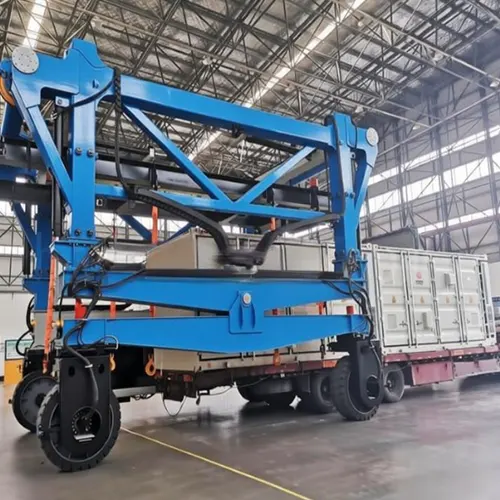
- Moves containers or cargo between warehouse and outdoor storage
- Works in low-clearance areas thanks to telescopic lifting
- Reduces manual handling and extra transport steps
Heavy Cargo and Industrial Logistics
- Handles steel coils, machinery, and other bulky items
- Provides stable lifting with balanced load distribution
- Useful for steel plants, heavy material yards, and industrial warehouses
Construction Material and Distribution Centers
- Moves pallets, containers, and modular loads efficiently
- Integrates easily into existing yard layouts
- Supports continuous flow of building materials
Port Buffer Storage and Staging Zones
- Temporary stacking and staging of containers
- Flexible placement for ships, trucks, or inland transport
- Reduces congestion and improves overall yard throughput
Telescopic Toplift Straddle Carrier Cycle / Yard Productivity
The telescopic toplift straddle carrier is designed to handle containers efficiently by combining lifting, transport, and stacking in a single workflow. Understanding the operational cycle helps industrial buyers and yard planners estimate productivity and optimize layout.
Typical Working Cycle
The system follows a straightforward, repeatable cycle for container handling:
- Container Pickup – Engage the container using the toplift spreader
- Vertical Adjustment – Use the telescopic system to reach the required stacking height
- Transport Movement – Move the container to the target location across the yard or warehouse
- Alignment and Stacking – Place the container precisely at the desired stack position
This integrated approach reduces handling steps and keeps operations smooth, even in busy yards.
Factors Affecting Performance
Actual productivity depends on multiple real-world conditions:
- Yard Layout Design – Narrow lanes or irregular layouts may slow movement
- Travel Distance – Longer travel between pickup and stacking points reduces cycle frequency
- Stack Height Requirement – Higher stacks require more precise telescopic adjustment
- Traffic Flow Density – Other vehicles or equipment in the yard can affect cycle time
- Operator Efficiency – Skilled operators can maximize system potential and reduce idle time
Telescopic Toplift Straddle Carrier System vs Other Systems
Choosing the right container handling system is not just about specs on paper. In practical yard operations, factors like stacking stability, mobility, and equipment coordination determine efficiency. The telescopic toplift straddle carrier system often competes with reach stackers, RTG cranes, and terminal tractor setups, but each has different strengths depending on the workflow.
Below is a side-by-side comparison to help industrial engineers and logistics planners make informed decisions:
| Feature / Equipment | Reach Stacker | RTG Crane | Terminal Tractor | Telescopic Toplift Straddle Carrier |
|---|---|---|---|---|
| Lifting Method | Fast single-point lift | Overhead rail lift | Requires separate crane | Toplift ISO corner lifting |
| Mobility | Good, but lane-limited | Fixed rail dependent | Mobile, but no lifting | Fully mobile over yard and warehouse |
| Stacking Capability | Limited stacking stability | High stacks, fixed zones | Dependent on separate lifting unit | Multi-height stacking, stable & flexible |
| Number of Units Needed | 1 per lift | 1 per crane lane | Multiple units for transport + lift | Single integrated lifting + transport unit |
| Yard Layout Adaptability | Moderate | Low (requires rails) | Moderate, depends on coordination | High (adjusts to changing layouts) |
| Operational Focus | Quick pick & place | High-capacity stacking | Container transport only | Combined transport + lift + stack |
This table highlights why many modern container yards and inland depots are adopting telescopic toplift straddle carriers. By combining mobility, multi-height stacking, and integrated lifting, a single machine can replace multiple specialized units.
In practice, this reduces coordination challenges, minimizes idle time, and allows for flexible yard layouts. Industrial planners can use this system to handle everything from standard ISO containers to heavier or irregular cargo, all in a single workflow.
Structural, Maintenance & Environmental Design Features
The telescopic toplift straddle carrier system is designed for real-world industrial use, where efficiency, reliability, and adaptability matter as much as lifting capacity. Its engineering combines robust structure, ease of maintenance, and environmental resilience to ensure smooth operations across different container yard and warehouse conditions.
Structural & Engineering Design Features
The machine's core structure is built to handle heavy loads while maintaining stability and operator safety. Key design elements include:
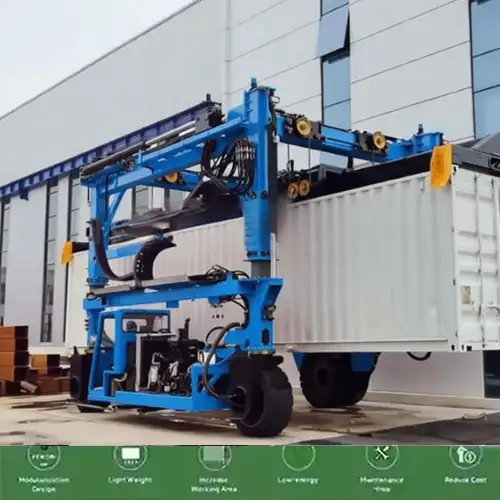
- Multi-wheel load distribution chassis – Spreads the load evenly across all wheels, preventing surface damage and improving stability on mixed terrains
- Telescopic mast stability control – Ensures smooth vertical movement and prevents sway during lifting
- Hydraulic synchronized lifting system – Maintains even load distribution during simultaneous lifting operations
- High-visibility operator cabin – Offers a clear view of the container, yard lanes, and stacking areas for safer operations
- Safety interlocks – Prevent accidental movement or lifting during transition, ensuring operator and load safety
Maintenance & Lifecycle Design
In practical industrial projects, easy maintenance is crucial to minimize downtime and keep yard operations continuous. The straddle carrier system incorporates:
- Modular hydraulic and electrical layout – Simplifies troubleshooting and part replacement
- Ground-level service access points – Allows quick inspections and repairs without lifting the entire machine
- Reduced downtime maintenance structure – Designed for easy swap of wear parts and routine service
- Standardized wear part replacement – Parts are interchangeable to reduce inventory needs
- Suitability for remote yard operations – Maintenance can be carried out with basic tools in areas with limited support
Environmental Adaptability
The straddle carrier is built to operate under diverse conditions commonly found in container logistics yards and industrial sites:
- Asphalt, gravel, or mixed terrain operation – Handles uneven surfaces without compromising stability
- Indoor warehouse transition – Telescopic function allows safe operation in low-clearance zones
- Dust, humidity, and heat resistance design – Protects critical components in harsh environments
- Stable performance on uneven surfaces – Chassis and hydraulic systems maintain balance during lifting and transport
How to Choose the Right Telescopic Toplift Straddle Carrier
Selecting the right telescopic toplift straddle carrier system is more than just looking at lifting capacity. In practical industrial projects, decisions should be based on workflow, yard layout, and long-term operational needs. A well-chosen system improves efficiency, reduces equipment redundancy, and ensures smooth yard operations.
Key Considerations Before Selection
Before committing to a purchase, evaluate the following critical factors:
- Container Flow Volume (Daily/Peak) – Understand the number of containers handled per shift to size the system appropriately
- Required Stacking Height – Confirm maximum and average stack levels to ensure telescopic lifting capacity meets yard needs
- Yard Layout Width & Lane Spacing – Check if the straddle carrier can navigate lanes safely and efficiently
- Indoor vs Outdoor Operation Ratio – Determine if low-clearance warehouse areas or open yards dominate operations
- Target Productivity per Shift – Estimate cycles per hour or per shift to match operational goals
- Future Expansion Plans – Consider upcoming yard growth or layout changes to ensure equipment scalability
In industrial projects, buyers often underestimate yard layout constraints or peak container flow. Taking the time to analyze these factors upfront ensures that the straddle carrier will be fully utilized, minimizes idle time, and reduces the need for additional backup equipment such as reach stackers or RTG cranes.
FAQ — Telescopic Toplift Straddle Carrier System
This section answers common practical questions about the telescopic toplift straddle carrier system, focusing on real yard operations, handling capability, and application differences. It helps clarify how the system performs in container terminals, depots, warehouses, and mixed industrial environments.
What is a telescopic toplift straddle carrier system?
A: It's a mobile container handling machine that combines telescopic height adjustment with toplift ISO container lifting.
- Designed for flexible container yard and warehouse operations.
- Lets operators lift and stack containers at different heights without relying on fixed cranes or rails.
What is the main advantage of using this combined system?
A: It allows one machine to handle multiple stacking heights while keeping container lifting standardized.
- Reduces the need for separate reach stackers or gantry cranes.
- Ideal for mixed-use yards or inland depots where container flow varies daily.
Where is it commonly used?
A: It's widely applied in container terminals, inland depots, warehouses, and port staging zones.
- Perfect for yards that need high-cycle container stacking and flexible layouts.
- Can transport containers directly between warehouse storage and yard blocks efficiently.
How is it different from a reach stacker?
A: Unlike a reach stacker that lifts forward with a boom, this system travels over containers and lifts vertically.
- Provides better stacking stability and lane efficiency in busy container yards.
- Useful in operations where precise placement and tight lane navigation are required.
Can it handle different container sizes?
A: Yes, it typically handles 20ft, 40ft, and 45ft ISO containers.
- Spreader design adjusts automatically to various container dimensions.
- Supports high-volume yards that deal with mixed container types, including reefers and high-cube containers.
Is it suitable for indoor warehouse use?
A: Yes, the telescopic lifting system allows safe operation in low-clearance indoor and semi-indoor zones.
- Works seamlessly between indoor storage areas and outdoor yard sections.
- Reduces manual handling and short-distance container transfers within warehouses.
What affects productivity in daily operations?
A: Productivity depends on yard layout, travel distance, stacking height, container flow, and operator efficiency.
- Narrow lanes or long travel paths can slow cycles.
- Multi-height stacking and high container flow require skilled operators to maximize the system's capacity.
Is it better than RTG cranes?
A: It depends on your yard's needs: RTGs excel in fixed, high-capacity terminals, while straddle carriers are better suited for flexible and expanding layouts.
- Straddle carriers adapt to changing container volumes, temporary storage zones, and mixed-use yards.
- They reduce reliance on permanent rail infrastructure and allow fast redeployment in industrial projects or port expansion.
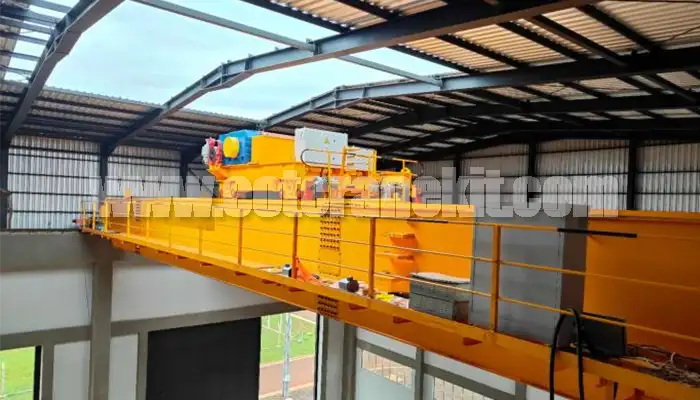
Latest project
150 Ton Overhead Crane Installation Feedback – Paraguay Case
QDX 150 ton overhead crane in action in Paraguay. Installation photos, video, and client feedback show performance, safety, and heavy-lifting efficiency.
Free consultation to Confirm Parameters & Specifications and Get
Latest Crane Price & Crane Rate.
- Types of overhead cranes : _______?
- Optional: Overhead travelling crane, goliath gantry crane,Slewing jib crane, Single girder or double girder crane,small portable crane or kbk crane, etc.
- Capacity of overhead crane: _______?
- Optional: 0.25ton, 0.5 ton, 1 ton, 2 ton, 3ton, 5 ton, 10 ton,15ton, 20ton, 25 ton, 30ton,35ton, up to 550ton, etc.
- Crane span & lifting height : _______?
- Crane travelling length : _____?
- Control of overhead crane:_______?
- Optional: pendant/ remote/cabin control
- Voltage supply of overhead crane:_____?
- Eg,: 380V50/60HZ,3Phase or others,etc.
- Application/usage of crane:_______?
- Eg,: Steel mill, ,injection mold, cement,stone, concrete,granite, general manufacturing, etc.
Just leave a message via the contact form and our hoist and crane engineer will contact you with in 24working hours.
Get In Touch